
As the wave of "Intelligent Manufacturing in China" sweeps across the globe and green energy transition becomes a global consensus, who is taking the lead in breaking through in the energy storage sector? Who is making China's energy storage solutions visible to the world through technological iteration and model innovation?
This time, CCTV has given the answer. Recently, Economic Information Network on CCTV Financial Channel launched a series of "Financial Observation" reports, focusing its lens on Narada Power. The reports highlighted that the company is becoming a "Chinese sample" driving industrial progress and development with its robust model of "technological iteration + in-depth ecological development".
In the first half of 2025, Chinese energy storage enterprises secured 163GWh of new overseas orders, a year-on-year increase of 246%. Against the backdrop of accelerated global energy transition, Chinese energy storage enterprises are witnessing a concentrated boom in overseas markets.
At the production base in Lin'an, Hangzhou, a batch of containerized energy storage systems from Narada Power is ready for shipment to India. Since the beginning of this year, energy storage demand in the Indian market has surged by ten times, entering a phase of rapid expansion. Indian customers stated that energy storage demand in India will grow substantially in the next three years, and Chinese suppliers including Narada Power will play a vital role.
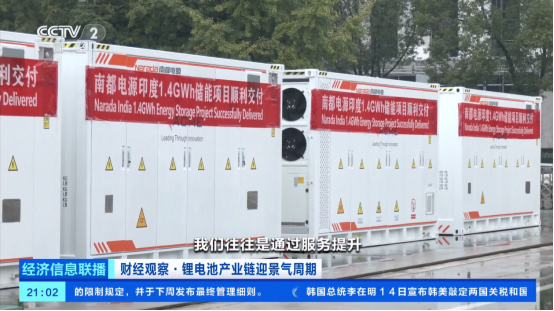
In addition to India, energy storage demand in emerging markets such as Eastern Europe has also increased by at least three times. These regions are just in the early stage of rapid energy storage construction, with particularly prominent growth momentum.
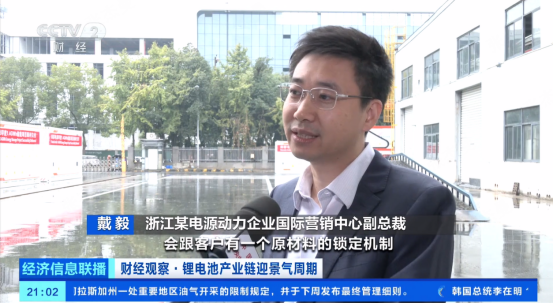
Dai Yi, Vice President of Narada Power's International Marketing Center, analyzed that emerging markets enjoy rapid development of new energy and are in urgent need of energy storage for regulation. Meanwhile, global energy storage has entered a stage of high cost performance, and green power projects such as photovoltaic and wind power with energy storage feature remarkable economic efficiency, creating favorable conditions for Narada Power's overseas expansion.
Full Capacity Utilization with Orders Scheduled Until Next Year
At present, the global energy storage industry is experiencing explosive growth, and China's new energy storage sector is particularly outstanding.
By the end of September 2025, the installed capacity of China's new energy storage exceeded 100 million kilowatts, accounting for over 40% of the world's total installed capacity, ranking first globally.
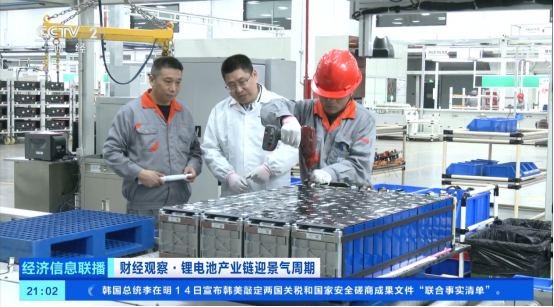
Amid such an industrial boom, Tan Jianguo, General Manager of Narada Power Lin'an Production Center, introduced that the energy storage capacity utilization rate of the production center has reached full capacity, with a daily production capacity of 20 megawatt-hours of energy storage products. This is equivalent to completing the production of 4 energy storage containers per day, and a single container can meet the daily electricity demand of nearly 50 households.
Seizing the New Blue Ocean of Data Center Energy Storage through Technological Iteration
Driven by the dual forces of policy expansion and the rapid development of AI large models, the electricity load of data centers has risen significantly, and energy storage enterprises are facing a critical period of product iteration and market competition.
In this context, Narada Power has demonstrated strong growth momentum and technological breakthroughs in the field of data center energy storage.
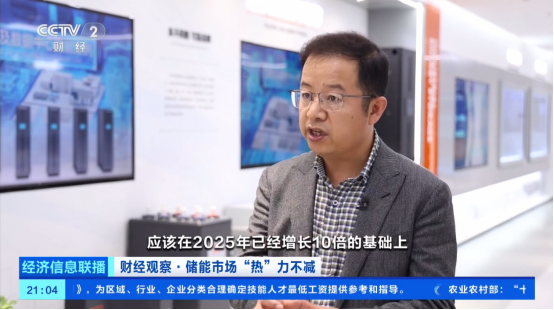
Liu Chenghao, Vice President of Narada Power, stated that boosted by the construction boom of AI data centers, the company's data center energy storage orders in 2025 increased by more than 10 times compared with 2024, and are expected to double again in 2026 based on 2025 figures.
This explosive growth stems from the rapid expansion of data center computing power brought by the development of AI technology, which imposes higher requirements on the reliability of power supply guarantee and power response speed.
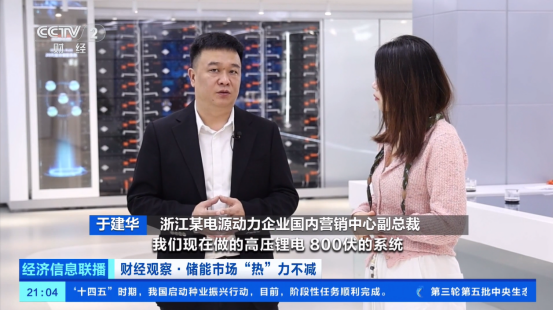
To adapt to the energy demand of high-computing-power data centers, Yu Jianhua, Vice President of Narada Power's Domestic Marketing Center, introduced that the company is launching a high-voltage lithium-ion 800-volt system, which will become an iterative product for fast response of emergency backup power in data centers.
Technological Iteration + Innovative Mechanisms
Against the backdrop of high prices of raw materials such as lithium hexafluorophosphate, cost control and market competitiveness of energy storage enterprises have attracted much attention.
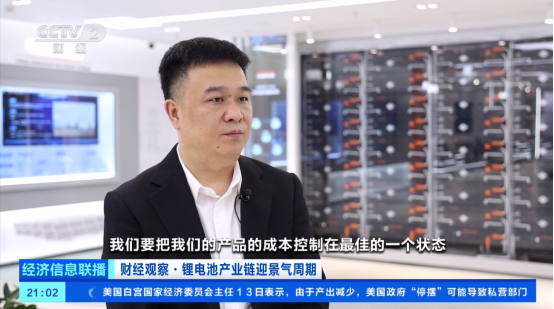
Facing fluctuations in raw material prices, Yu Jianhua, Vice President of Narada Power's Domestic Marketing Center, introduced that the enterprise controls costs within a reasonable range through large-scale production, stable order support and product technological iteration.
Taking the prefabricated modular lithium iron phosphate energy storage system as an example, breakthroughs have been made in the integration of 20-foot cabins, with the cell capacity increased from the original 3,000 kWh to 5,000 kWh. The ultimate integration optimization has effectively reduced equipment costs.
In the field of semi-solid batteries, compared with traditional batteries, although the cost has increased slightly, the safety and reliability have been significantly improved, and heat generation during use is reduced, fundamentally avoiding risks such as thermal runaway and extreme fire and explosion, and building a solid line of defense for the safety performance of energy storage products.
In the international market layout, Narada Power has also explored a unique response strategy. Dai Yi, Vice President of the International Marketing Center, said that the company does not adjust prices simply based on the rise and fall of raw materials, but strives to enhance service value.
When raw material fluctuations exceed a certain proportion, the company will establish a raw material locking mechanism with customers; when fluctuations are within a small range, it communicates with customers by improving services, so as to cope with upstream cost fluctuations and stabilize the international market share.